Education
CPR Training Guide
A plain-language overview for someone comparing CPR, AED, first aid, and Basic Life Support before choosing a class. It is not a course and it does not register you.
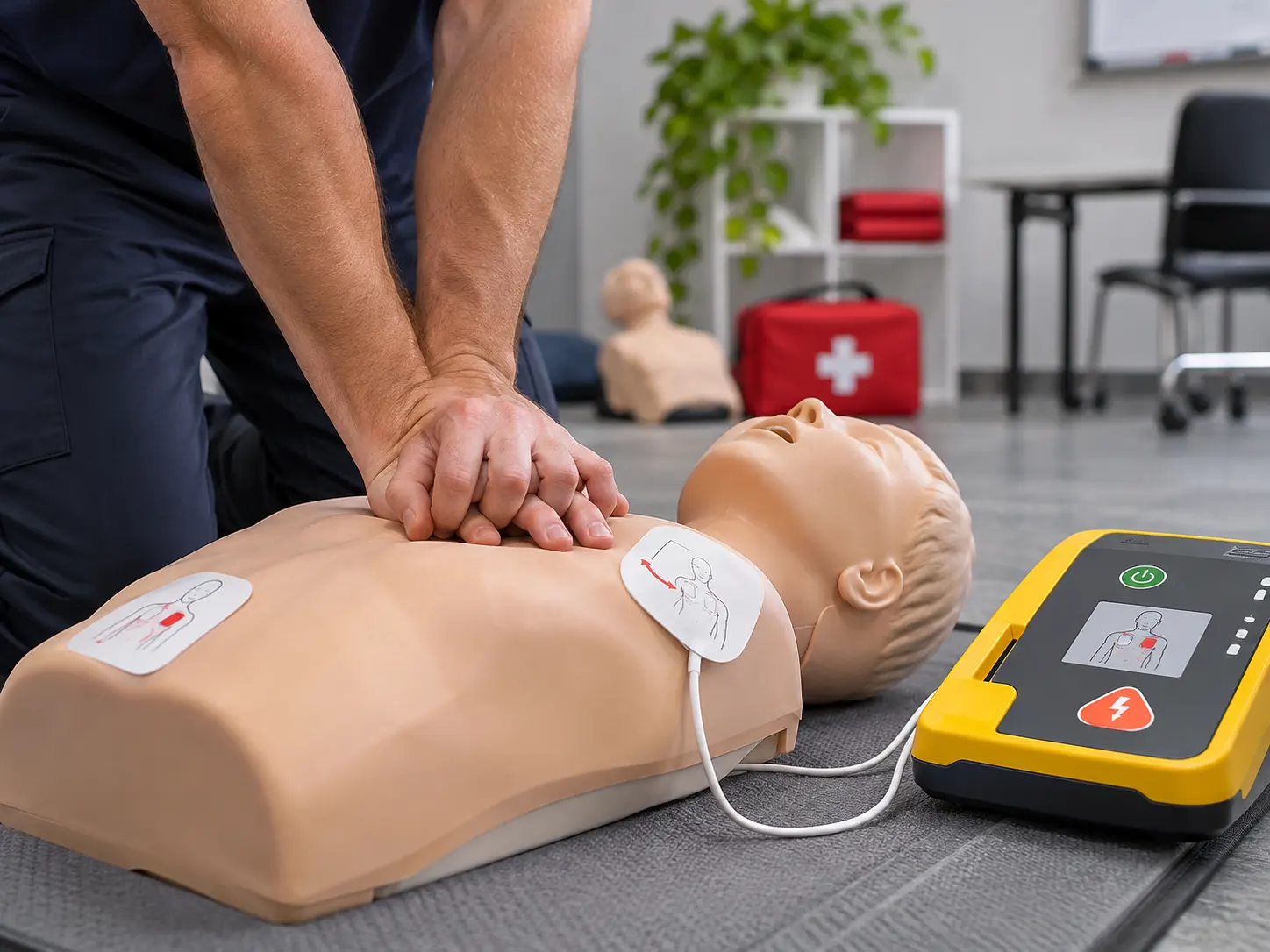
The photograph shows a training manikin and a training AED. It is not a Code Blue class. In an emergency, follow the AED voice prompts and the dispatcher.
Immediate CPR can double or triple the chance of survival after an out-of-hospital cardiac arrest. American Heart Association CPR Facts and Statistics (opens in a new tab). The American Heart Association reports this as a population-level association. It is not a guarantee for any one emergency.
What Is CPR?
Cardiopulmonary resuscitation, or CPR, is an emergency procedure used when someone's heart has stopped beating. The American Heart Association describes it as a lifesaving procedure and places early CPR in the chain of survival, alongside calling for emergency medical help.
CPR is a bridge until professional responders take over. It is not a substitute for emergency medical care, and reading about it is not the same as practicing the skill.
What Is an AED?
An automated external defibrillator, or AED, is a device that can check a heart rhythm and deliver a shock when a shock is advised. It is used together with CPR during sudden cardiac arrest, not as a replacement for CPR.
Familiarity with an AED is a common part of CPR training. The steps on this page are not instructions for operating a device in an emergency.
What Does CPR Training Involve?
A typical class introduces how to recognize an emergency, how to activate emergency medical services, CPR technique, AED familiarization, and, when the course includes it, hands-on practice and a skills assessment.
Actual course content varies by organization, audience, and delivery format. Code Blue has not published a class-by-class curriculum.
Types of Training
CPR/AED training focuses on adult cardiac emergencies and defibrillator familiarization. First aid covers common injuries and sudden illness. Pediatric CPR and first aid is aimed at people who care for children. Basic Life Support is commonly intended for healthcare professionals and other personnel who need specific resuscitation skills, including team response.
These topics are not substitutes for one another. An employer or licensing body may require one of them and not the others.
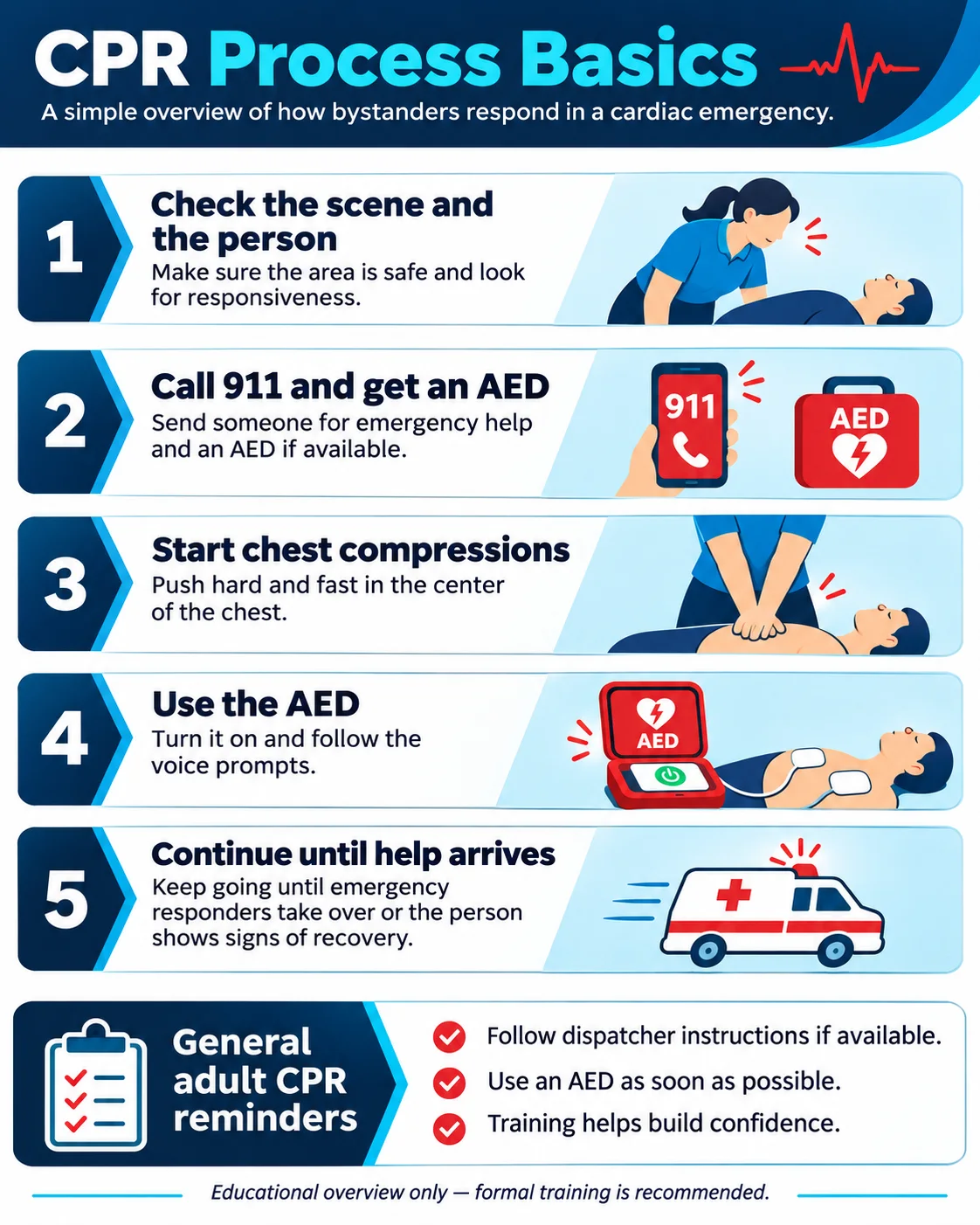
Adult response overview
This is a general adult bystander sequence. It is not infant CPR, it is not hands-on instruction, and it is not a substitute for directions from a 911 dispatcher.
- Check that the scene is safe and check the person.
- Call 911 and send someone for an AED.
- Start chest compressions on the center of the chest.
- Use the AED and follow its voice prompts.
- Continue until professional responders take over.
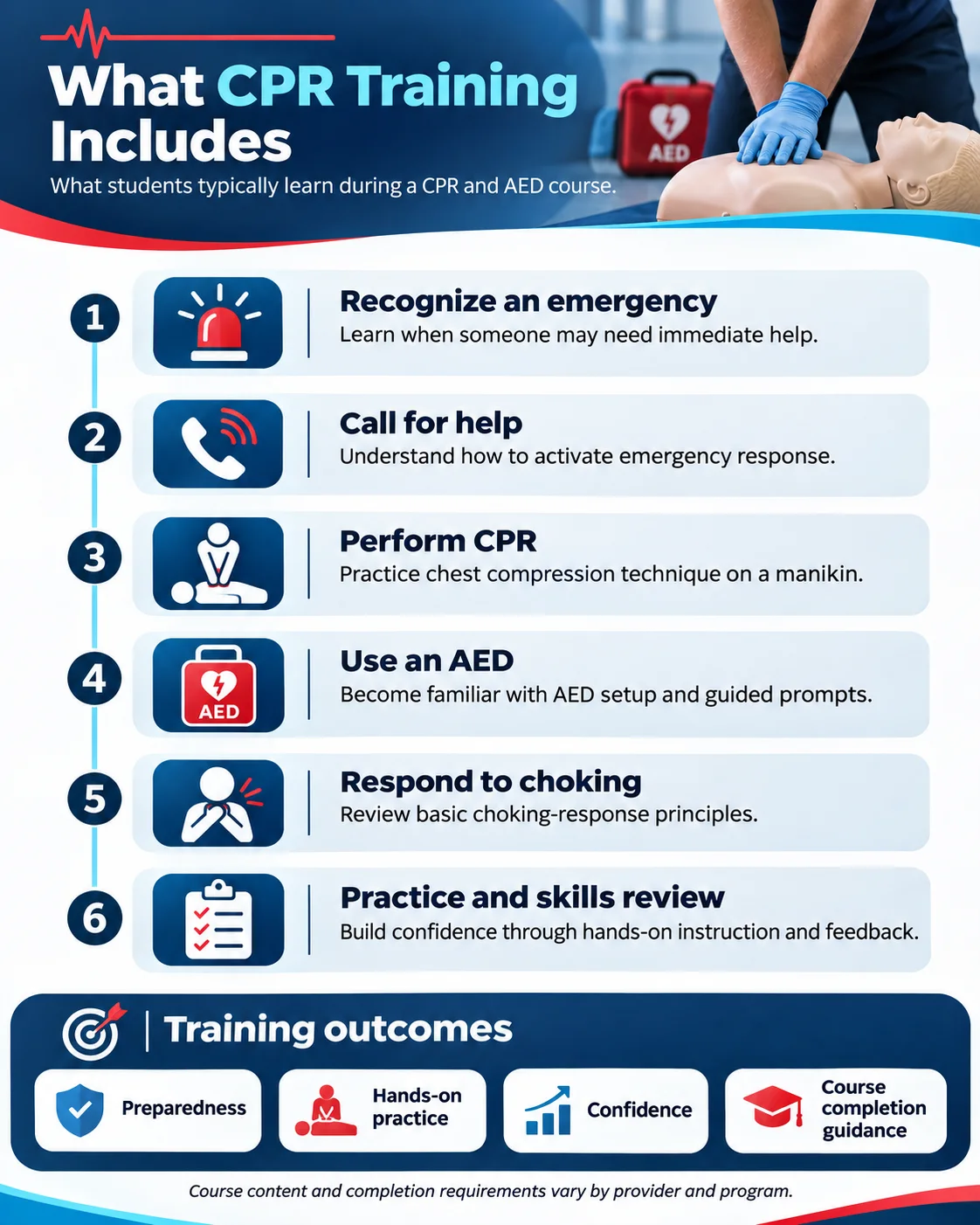
What training includes
- Recognizing an emergency.
- Calling for help.
- Practicing CPR on a manikin.
- Becoming familiar with an AED trainer.
- Responding to choking.
- Reviewing skills with an instructor.
The same six topics are written here so the graphic is not the only source.
How Certification Works
An issuing organization decides whether a certificate or completion card is awarded. Code Blue Training Associates has not confirmed that it issues American Heart Association or American Red Cross credentials.
1
Select appropriate training
Match the course to the setting, such as community CPR/AED, first aid, pediatric care, or Basic Life Support. These course types are not interchangeable.
2
Complete required instruction
Instruction may be in person, online, or a blend of both. The issuing organization decides which parts are required.
3
Demonstrate required skills
American Heart Association programs that lead to a CPR skills credential include a hands-on assessment. Red Cross workplace certification also requires an in-person skills assessment.
4
Receive applicable completion documentation
A certificate or completion card is awarded only when that organization's requirements are met. This website does not issue another organization's card.
Online Versus Hands-On Training
Online education can teach concepts at the learner's pace. Blended learning pairs that online portion with a later skills session. In-person instruction keeps the learner with an instructor for the class, including skills practice.
The American Heart Association's Basic Life Support options that start online still include a hands-on skills session before a course completion card is issued. The American Red Cross states that online-only CPR classes do not qualify for workplace certification and that an in-person skills assessment is required for that purpose.
Credential Validity
Many common American Heart Association BLS completion cards and American Red Cross CPR certifications are valid for two years after successful completion. That period is set by the issuing organization for those credentials.
Other programs can use a different period. Students should confirm acceptance and renewal rules with the employer and the organization that issued the card.
Workplace Requirements
OSHA explains that employers must provide medical and first aid personnel and supplies that match the hazards of the workplace, and that the details depend on the circumstances of that workplace. The general-industry standard, 29 CFR 1910.151, requires trained first-aid personnel when an infirmary, clinic, or hospital is not in near proximity.
No single CPR course is universally compliant. OSHA does not accredit Code Blue Training Associates, and OSHA does not issue Code Blue's CPR cards.
Independent references
National training resources
These organizations publish the pages linked here. The links are independent educational references. Code Blue Training Associates is not affiliated with, accredited by, or endorsed by the American Heart Association, the American Red Cross, or OSHA.
American Heart Association
CPR Facts and Statistics (opens in a new tab)
Official American Heart Association summary of CPR and out-of-hospital cardiac arrest, including the statement that immediate CPR can double or triple the chance of survival.
Reviewed 2026-11-01
American Heart Association
Course Catalog and BLS Training (opens in a new tab)
Official catalog for American Heart Association courses. Basic Life Support course options describe hands-on skills practice, and the BLS training page states that a BLS Provider course completion card is valid for two years.
Reviewed 2026-11-01
American Red Cross
CPR Training and Certification (opens in a new tab)
Official Red Cross explanation of CPR certification, including the distinction between online-only classes and the in-person skills assessment used for workplace certification, and a two-year certification period.
Reviewed 2026-11-01
Occupational Safety and Health Administration
Medical and First Aid (opens in a new tab)
Official OSHA overview of workplace medical and first aid expectations. The page states that program details depend on the circumstances of each workplace and employer.
Reviewed 2026-11-01